
Our history
From samurai-era Japan, through post-war Brisbane, to our dojos today.
The Kyushin Ryu school
During the Edo period (1600 to 1868) several Jujitsu styles became paramount, each focusing on techniques its masters had developed over time. The Kyushin Ryu school specialised in Atemi waza (striking techniques). The art was practised by many shoguns, who specialised in attacking the exposed target areas outside an opponent's armour.
Credit for founding the Kyushin Ryu school is given to Inugami Sakon Shogen Nagakatsu during the Eiroku period (1558 to 1569). He compiled a book explaining the basic principles of the style, which specialised in Atemi waza (striking with the legs and arms) and Katsu waza (methods of resuscitation and first aid).
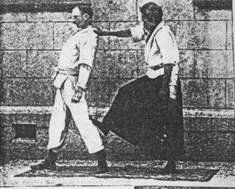
The most noteworthy master of Kyushin Ryu Jujitsu in more recent times is Shihan Yoshinori (Yazo) Eguchi, who was recognised by Dr Jigoro Kano during the formation of modern Judo in the early 1880s. Dr Kano selected techniques from the five major Jujitsu schools: Yoshin Ryu, Kito Ryu, Takenouchi Ryu, Daito Ryu and Kyushin Ryu. Eguchi Shihan became one of Dr Kano's closest disciples in those early years.
From Iwakuni to Brisbane
One of Eguchi Shihan's senior students was Minehiko Nakano of Yamaguchi Prefecture. After World War 2 he lived in Iwakuni, near Hiroshima, which became the site of an American marine base, and he was persuaded to teach Jujitsu there. One member of the Australian occupation forces, Mr Ray Stevens of Brisbane, also learnt from Nakano.
Ray Stevens brought the art to Brisbane in the early 1950s, where he joined Dr A.J. Ross and passed his knowledge on to several martial artists, including John Lee Jones, Desmond de Vene, Jim Stackpoole and Joe Elkenhans.
Kyushin Ryu schools have been established in various parts of the world; the best known was founded in London in the late 1940s. The traditional techniques taught by Eguchi Shihan have been kept, while some aspects of the art have changed with the times, especially around safety. The Kyushin Ryu School of Jujitsu is the only follower of the Kyushin Ryu style in Australia.
A brief history of Jujitsu
In the beginning
No records establish exactly where Jujitsu began. Since the beginning of history, the instinct for self-preservation pushed people to develop skills for using the body in attack and defence, and that is the root of all martial arts.
Muromachi period (1333 to 1573)
Early Japanese warriors were highly skilled with swords, but also needed to defend themselves when they couldn't use one. They studied striking, kicking, throwing, joint locking and choking: the formal beginning of Jujitsu, although references to unarmed defence go back to the 11th century. Early Jujitsu was secretive, with each family or province passing techniques only to its own members. This continued until the late 16th century, when Jujitsu became formalised and many significant ryu (schools) formed.
The formation: Edo period (1600 to 1868)
Kyushin Ryu brought forward systems of Atemi waza (striking) and Kappo (resuscitation). Kito Ryu brought an order of training from basic to advanced and emphasised throws; modern Judo is based on its techniques. Takenouchi Ryu emphasised Hojo (rope tying), still used by many police and military groups. Daito Ryu specialised in Kansetsu waza (joint locks) and Atemi waza, and modern Aikido is based on its joint techniques.
The turning point: Meiji period (1868 to 1911)
When the feudal system collapsed and imperial rule returned, weapons could no longer be carried and many Jujitsu styles began to die out. Jigoro Kano developed Judo, and in tournaments under Judo rules (no striking or kicking) Judo often won. It was the Japanese police who revived Jujitsu: they added the striking and kicking techniques they still needed to Judo and developed Taiho-jitsu.
Modern Jujitsu (1912 to today)
By the twentieth century Jujitsu was becoming known in the West. After World War 2 the occupying forces banned martial arts training in Japan, and many traditional activities almost disappeared. As the ban eased, traditional schools reopened, led by police forces who adopted many Jujitsu techniques. Jujitsu re-emerged in Japan and spread to the Western world.
One of the most prominent figures in Australian Jujitsu was Dr A.J. Ross, who formed the first Jujitsu school in Australia in Brisbane in 1926. Many of his students went on to lead Jujitsu schools across Australia.