
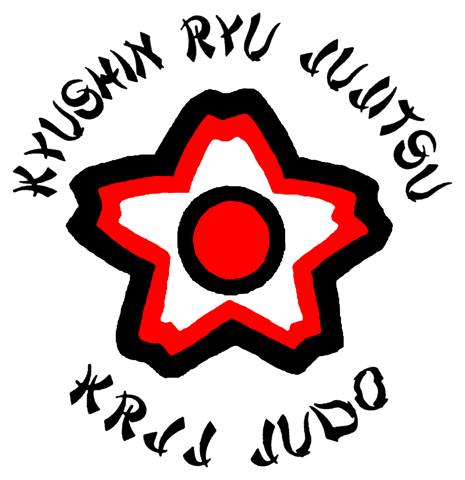
The Kyushin Ryu badge
Worn on the upper left of the gi jacket, over the heart.
In the late 19th century, Eguchi Shihan traced the roots of the Kyushin Ryu system to five prominent Jujitsu schools that had pooled their knowledge over time:
- Shindo Munen Ryu
- Kyushin Ryu
- Enshin Ryu
- Takenouchi Ryu
- Sekiguchi Ryu
To thank each school, a five-branched star was created. So that no school was more important than another, none of the branches comes to a point. Each branch is curved like a cherry blossom petal, a flower famous and loved in Japan.
The red circle in the middle stands for the red sun of Japan, the land of the rising sun. The star and sun are outlined in black so that the red and black stand out: red for the "blood sport" of fights to the death in samurai days, and black for the master-level belt Kyushin Ryu practitioners can reach.
What the name means
- Kyu means level, or position of status.
- Shin means supreme, superior or aristocratic. It refers to the class of society who traditionally practised the system. Many older members of the Japanese aristocracy chose Kyushin Ryu: its Atemi waza, attacking parts of the body not protected by armour, finished a fight quickly and suited shoguns who were past the age of heavy physical demands.
- Ryu means style, or method of application.
So "Kyushin Ryu Jujitsu" can be translated as the supreme level of Jujitsu, where "supreme" refers to the aristocracy who practised it rather than a comparison with other styles. As the shoguns were among the highest level of Japanese society, the star became the badge's main feature.